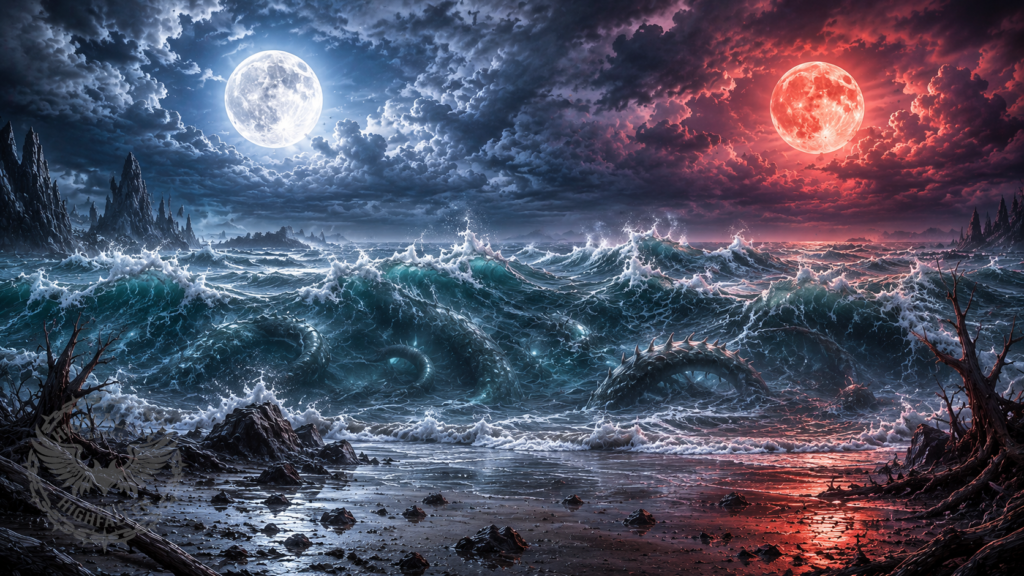
Feota’s Gaze
Yaesal, the world of Thanria, has two moons. The larger is Lyra — silvery, steady, tracing a nearly circular orbit that makes her a reliable presence in the night sky. The smaller is Phynri — redder, more restless, following an elliptical path that swings her closer to the world at its nearest point than Lyra ever gets. Under normal circumstances, the two moons appear quite different in size. But every five hundred and eighty-one days, Phynri reaches the closest point of her orbit at the exact moment both moons are full. When that happens, the two sisters hang in the sky appearing precisely the same size — and the night that follows is called Feota’s Gaze.
For those on land, Feota’s Gaze is something to look forward to. The combined light of both full moons at their brightest floods the world with a luminescence so intense that the night sky never gets darker than it would be at dusk or just before dawn. Torches are helpful but not strictly necessary. Roads that would normally require careful navigation by lantern become easy to traverse. Caravans plan around it. Travelers time their journeys to take advantage of it. For one extraordinary night every five hundred and eighty-one days, the darkness simply does not come, and the world is bathed in cool silver and pale red light from horizon to horizon.
On the seas, it is a different matter entirely.
No reputable captain — and few disreputable ones — will willingly be on open water during Feota’s Gaze. The gravitational pull of both moons at their combined closest and fullest transforms the oceans into something that barely resembles water anymore. Waves that would capsize most vessels in ordinary storms rise to heights that make experienced sailors go pale describing them. The tides do not simply swell — they rage, violent and almost alive, battering hulls and swamping decks with a ferocity that gives even the heaviest warships pause. This alone would be reason enough to stay in port. But it is not the only reason.
The same tidal forces that turn the surface of the sea into a maelstrom also disturb whatever lives far below it. Creatures that spend their existence in the deepest, darkest reaches of the ocean — things that most people have never seen and most sailors desperately hope to never see — are drawn upward on the night of Feota’s Gaze. What surfaces varies. What they all have in common is that none of them are inclined toward mercy. From the lowest cabin boy to the most seasoned ship’s captain, the understanding is the same and universal: any vessel that braves Feota’s Gaze does so at its own peril. And that peril, in the long and well-documented history of ships that have tried, is one that is almost certainly fatal.
Feota herself is at the height of her power during the Gaze. Whether the chaos of that night is her doing, her delight, or simply a natural consequence of the world she governs is a question theologians have debated for centuries. Most sailors don’t particularly care about the answer.
They just stay in port.